
2025: on work, life and the signal in the noise
2025 ✅
sayonara 2025 👋. a year of oscillation between high-frequency work and low-frequency living.

work
this year, i chose to accept the role of principal engineer at Qoria.
first, a nod to the roads not taken. big thanks to montu and genomical for the lucrative offers. i hope the bridge isn’t burnt, but i couldn’t say no to qoria this time. it was a bet on the mission, and a chance to join forces with Jen Marfell again.
i must admit, my understanding of edtech was… naive. i thought it circled mostly around learning management systems like moodle or examination monitoring. basically, digital administrative work. but Qoria operates on a different scale, and my shallow understanding of the engineering required to keep the k-12 audience safe from bad actors (and the absolute bottom-of-the-rock-bottom demographic of demonic pedophiles) was washed away pretty quickly.
as a first time parent to a baby girl, the resolution of this problem changes. speaking strictly as an outsider (and to be clear, i’m not here to earn brownie points with my employer; i’ve outgrown the need to sugarcoat) i have a newfound respect for this problem space. as in, it goes beyond the traditional problems technology companies usually solve. and i don’t mean those problems are “lesser,” but i am at a stage in life where “value add” means something very different to me than it did in my 20s. keeping the digital world safe for kids hits a frequency that optimizing ad clicks or selling widgets just doesn’t anymore. the absolute worst thing we can do is: expose the eager, vulnerable young minds to the awful corners of the internet. so to the folks across linewize, smoothwall, and qustodio: thanks is an understatement. not as an employee, but as a parent.
on the technical front, it’s been a refresh. before this, my experience with MiTM was mostly limited to hobby projects or tinkering with DNS servers (and blaming DNS for every hairy p0 incident.. because it’s always bloody dns, right?) or setting cloudflare’s 1.1.1.1 for privacy was about the extent of it.
but getting into the nuts and bolts of a filter product at this scale (circa 27 million users) is a different beast. it’s an amalgamation of low-level interceptors, packet sniffing, chromium extensions, and dns filtering. it’s not easy to create an effective filter that works hard to keep the bad stuff away from toddlers. and, to be part of this cohort has been rewarding. the engineering here is everything but mundane.
not related to Qoria specifically, but i also penned down my views on what a staff+ engineering role actually entails. this isn’t about one company or one role; it’s an amalgamation of the friction i’ve observed over the last six years in staff+ roles across the industry. (standard disclaimer: views are my own, accumulated over time, and not directed at any single workplace). you can read that rant here.
life
it’s been a year of moments that will definitely make the final 7-minute neural playback.
my daughter turned one a few weeks ago.

we’ve had a combination of awesome, nerve-wracking, and anxious moments as amateur parents in a nuclear family. i’ve dealt with nephews and nieces sure… but when it’s your own, as vouched by many already, i admit that it’s a different ball game. as clichéd as it sounds, the protective switch flips, and there is no match for it.
about a year into this blessed parenthood gig, i have this to say: utter, floor-scraping respect to the real-life gladiators. especially the ones in high-rpm careers who teleport home to slay laundry dragons, decode baby babble, and still remember their partner’s name - all on five minutes of sleep and a gummy smile. some mythic beast mode kicks in. utter respect!
(and if you’ve got a nanny, cook, maid, driver, and still act wrecked when the nanny is late or a nap is skipped - ROFL 🤷♂️)
this is also the year i finally got sick of the “social” platforms. there is something deeply sickening about infinite scrolls. i’m glad my wife is joining me on this journey to be mindful about our time. privacy is the real luxury. being mindfully present, instead of being subdued by the constant “ding” of a notification, is imho the most expensive gift you can give yourself. an outsider perspective is all it takes to see the poisonous atrocities of these platforms.
we are choosing to opt out.
on the hardware front, my wife & i took on a new project to build a verandah.

i’m not a DIY person. never have been. the mere thought of measuring twice, cutting once, and then realizing i measured wrong anyway - that’s my default state. but this year, i pushed through. no idea where the motivation came from, but i’m glad it showed up. couldn’t be happier with how it turned out.
and while we’re on things that made me stop scrolling - this photo by andrew mccarthy:

i don’t know what it takes to capture something like this, but i’m jealous of the skill. absolutely stunning. hats off.
hobbies
my hobbies are becoming recursive. i seem to be building tools to debug my own brain.
cipher: i built cipher to find clarity in randomness. it’s a journaling system, but not for “dear diary” moments. it’s an attempt to quantify the qualitative - using bayesian reasoning to find the signal in the noise of my own daily thoughts. it helps me see the space between notes.
consult: you can’t surprise yourself. that’s a bug in human cognition. so i built consult - a cli tool that spins up a legion of llm agents to peer-review my architecture. it’s structured friction. it’s rubber-ducking, but the duck bites back.
tomatick: productivity tools usually misunderstand how brains work. they treat us like i/o machines. tomatick is my attempt to engineer flow state and manage decision fatigue, rather than just counting down minutes.
i build these not to sell, but to survive the entropy.
books: reading is my defrag routine. here’s the full stack from 2025:
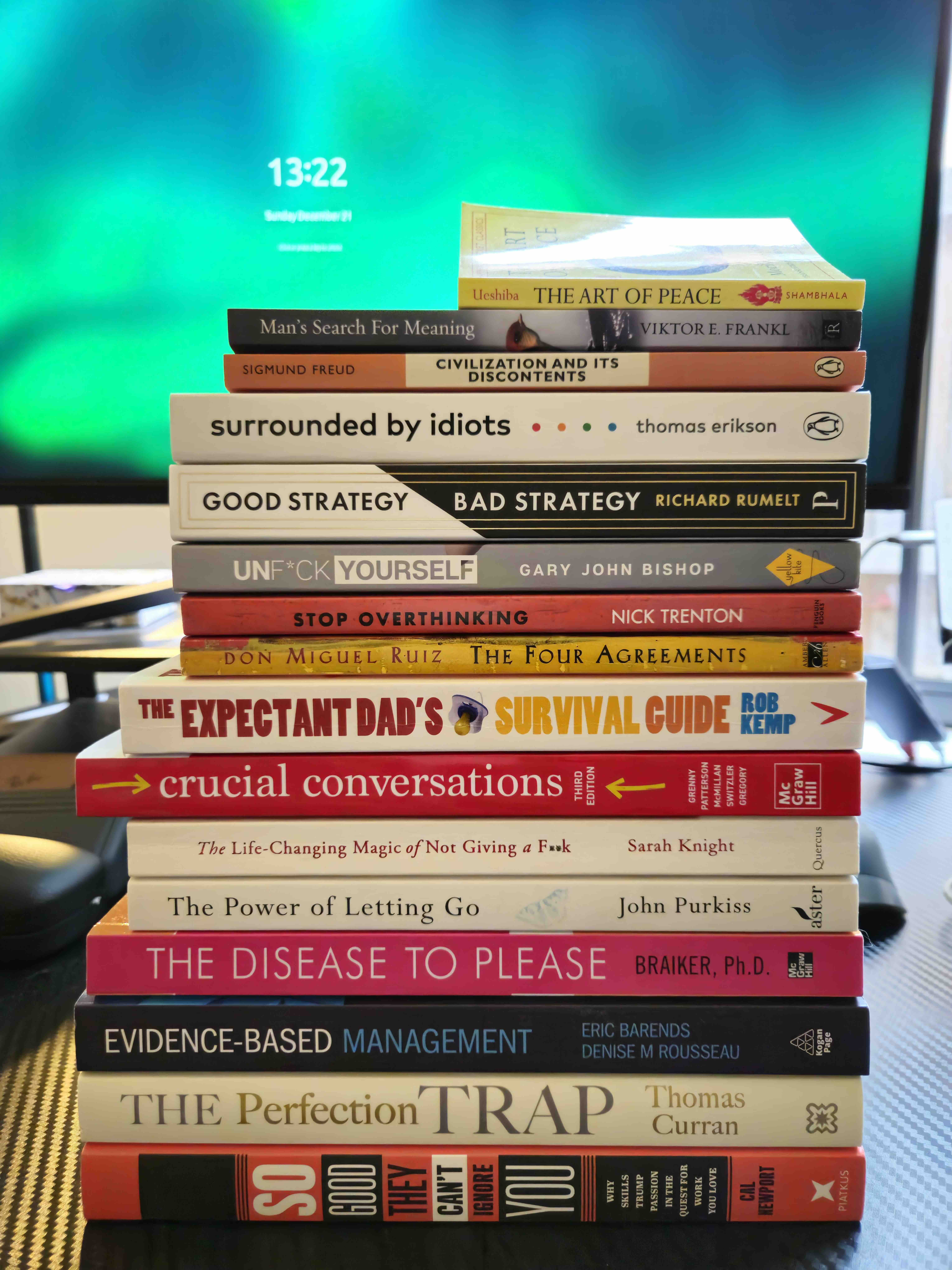
and then there’s the annual re-reads. three years running now, i force myself through these cover to cover. not because i forgot what’s in them, but because knowing and doing are different muscles (imo).
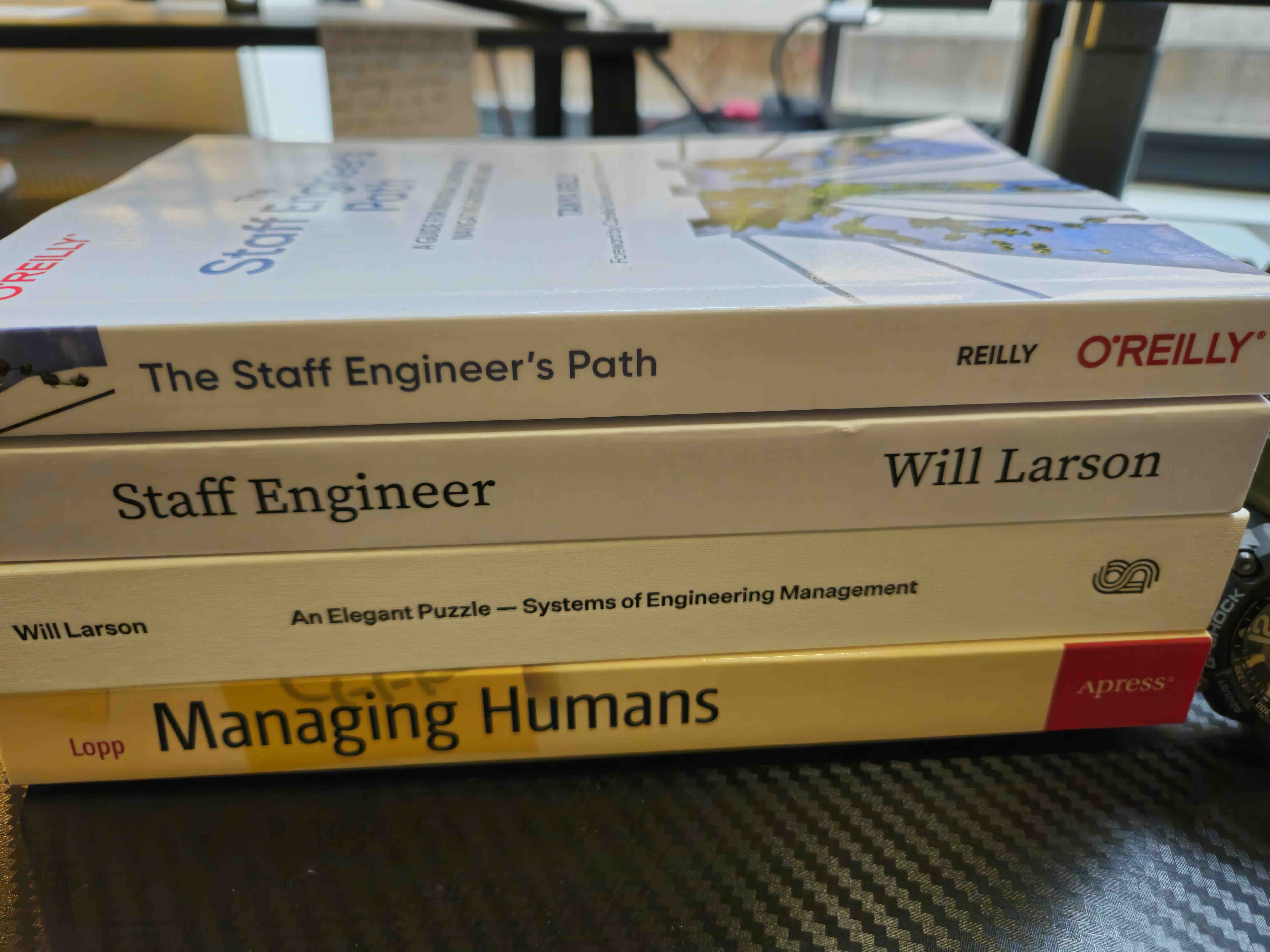
if your career intersects with mine (distributed systems, engineering leadership, or the perpetual existential crisis of scaling teams and tech simultaneously), you might find these worth a loop too.
ai
here’s the deal. as someone who has historically side-eyed every tech fad with the enthusiasm of a cat being offered a bath, i can’t ignore this one anymore. the skepticism is warranted. techreviewer reports that favorable views of AI tools dropped from some 70 +% to ~60% between 2023 and 2025, and about 46% of developers don’t trust AI output accuracy (im one of them for sure). but the productivity gains, even modest, are measurable. afaict, this isn’t hype anymore - it’s a tool that demands fluency, not faith.
that said, i’m allergic to how this has become a hammer looking for nails. not every problem needs an llm thrown at it. the 2025 “hype correction” is real - companies rushed to deploy without strategy, and now the hangover is setting in. chatgpt, claude, and friends don’t “think” - they regurgitate patterns with supreme confidence. they drift, hallucinate, and have no innate sense of why they offer one answer over another. that’s not a tool for every nail. that’s a tool for specific nails, wielded by someone who knows the difference.
which brings me to the guru infestation. this is probably the tech revolution of our lifetimes, rightly so. but it’s also become embarrassingly easy for “experts” to materialize from thin air. princeton researchers wrote an entire book on this - AI Snake Oil - calling out the gap between scientific possibility and popular comprehension. afaict, the tells are obvious: genuine specialists specify their domain; gurus retreat into metaphor when you ask about transformer architectures. just because you can afford $20/month for a subscription that blurts out confident-sounding paragraphs doesn’t make you an expert 🤷♂️. if you can’t challenge the good, bad, and ugly of what the model produces, you’re not an expert - you’re a middleman with a clipboard. the epistemic pollution is real. linkedin is drowning in it.
and then there’s vibe coding. probably word of the year for 2025 (?). andrej karpathy’s phrase for “fully giving in to the vibes, embracing exponentials, and forgetting that the code even exists.” here’s my problem: to vibe about something, you need to know that domain. i’m an engineer - i can’t “vibe” my way through neurosurgery or docking rockets. sure, i can ask questions and get text back (that was called the internet, right?), but trusting that output in plain sight, letting it build systems, and exposing users to those systems? imo, that’s fraud in broad daylight. and now we have “vibe saas” apps? built by folks who couldn’t explain a sql injection if their funding depended on it, but are suddenly “teaching” others how to build? simon willison said it well: “vibe coding your way to a production codebase is clearly risky. most of the work we do as software engineers involves evolving existing systems, where the quality and understandability of the underlying code is crucial.” the development hell of inheriting vibe-coded repos is already upon us.
(and honestly? linkedin needs its own subreddit-style moderation. the “i built this in 2 hours with ai, let me teach you” posts are insufferable. where are the ruthless redditors when you need them?)
but here’s where i’ll give credit: guided learning. this is where (imho) llms shine. i finally coughed up for a subscription - not to build, but to learn. specifically, learning haskell. but not in isolation - with side-by-side translation from rust and typescript. the model becomes a rosetta stone: “here’s how you’d express this monad in haskell, here’s the equivalent in rust with Result<T, E> and ? operator, here’s how typescript’s Promise chain approximates it.” i can interrogate the differences, challenge the abstractions, and build mental bridges between paradigms i already understand. this is structured learning with a tutor that has infinite patience and speaks every language. imho, this is the highest-value use of llms: accelerating learning for people who already have the foundation to challenge the output.
- done.
a year of signal, noise, and the attempt to distinguish between the two.